Fleet management software is a broad category. One product may focus on tracking vehicles and fuel; another may manage workshop jobs, leasing costs or telematics. Transport manager compliance software has a different centre of gravity: it helps a transport manager control responsibilities, record decisions and show what was done.
The categories overlap, but they are not interchangeable. A system can know where a vehicle is without knowing whether its safety inspection evidence has been reviewed. It can calculate cost per mile without recording who chased an open defect or what was agreed at the monthly compliance review.
What fleet management software usually covers
Fleet management systems are commonly bought to improve operational and financial control. Depending on the product, typical functions include:
- vehicle location and telematics;
- fuel use and mileage;
- route performance and driver behaviour;
- vehicle acquisition, leasing and disposal;
- workshop scheduling and parts;
- service, repair and maintenance costs;
- insurance and incident records;
- utilisation and replacement planning.
Those functions can be valuable, especially where a fleet team needs live operational data or whole-life cost reporting. They do not automatically create a transport manager’s compliance system.
What transport manager compliance software should add
The compliance layer connects records to responsibilities and follow-up. It should make it possible to see not only that an event occurred, but how it was assessed, what action followed and where the evidence is retained.
That normally requires:
- operator licence and appointment context;
- clearly scoped operator, vehicle and driver records;
- safety inspection and MOT dates;
- driver defect reports and rectification evidence;
- driver licence, CPC and disclosure checks;
- monthly reviews and an oversight diary;
- tasks with owners, priorities and due dates;
- documents linked to the record they support;
- an action history that remains available after closure;
- reports suitable for an operator meeting or evidence request.
Where the systems overlap
Vehicles and maintenance dates
Both products may hold a vehicle registration, make, model, MOT date and maintenance schedule. The difference is often what happens next. A compliance system should turn missing or approaching dates into visible work and retain the response.
Defects
A fleet product may send a defect to a workshop. A compliance product should preserve the report, severity, vehicle-off-road decision, photographs, repair evidence, rectification date and review trail. These can be connected processes rather than duplicate entries.
Drivers
Telematics may score driving events. Compliance records may cover licence checks, penalty points, Driver CPC, declarations, training and the action taken after an infringement or concern. One set of data can inform the other, but the purpose is different.
Reporting
Operational reporting asks how the fleet is performing. Compliance reporting asks whether the system is controlled and whether evidence can be produced. A strong management view needs both questions.
Why an electronic record is useful but not enough
The DVSA Guide to Maintaining Roadworthiness says electronic vehicle maintenance systems can provide effective management of safety inspections, scheduling and driver defect reporting. It also makes clear that a system alone cannot ensure roadworthiness; supervision and effective management remain essential.
That distinction matters when assessing software. The product should support decisions by a competent person, not suggest that buying a system creates compliance. Look for controls that make follow-up visible and make the evidence available for examination.
Which product should you choose?
Choose a fleet management platform first when:
- live location, routing, fuel or utilisation is the main business need;
- the workshop requires parts, labour and job costing;
- vehicle acquisition and whole-life cost decisions drive the project;
- the compliance workflow is already controlled elsewhere and integrations are available.
Choose transport manager compliance software first when:
- important dates are spread across spreadsheets and personal calendars;
- open defects and follow-up actions are hard to see;
- evidence is held in inboxes or folders without a clear record link;
- monthly reviews do not produce a consistent action trail;
- an external transport manager needs a portfolio view across operators;
- the immediate risk is weak control rather than weak cost reporting.
Many operators will need both. The practical question is which system owns each record. Avoid entering the same safety inspection, defect or driver detail in several places without a clear source of truth.
A simple ownership model
| Record or workflow | Likely primary system |
|---|---|
| Live vehicle location and route history | Fleet or telematics platform |
| Fuel, mileage and utilisation | Fleet management software |
| Workshop labour and parts | Maintenance or workshop system |
| Safety inspection due date and evidence review | Transport compliance software |
| Defect report through rectification | Integrated fleet/compliance workflow |
| Monthly compliance review and actions | Transport compliance software |
| Transport manager portfolio and appointment context | Transport manager software |
How ETM Desk approaches the overlap
ETM Desk is not positioned as a telematics or dispatch replacement. It provides the working layer for transport managers: operators, vehicles, drivers, tasks, calendar dates, defects, reviews, evidence and reporting. Vehicle registration lookup helps begin a record, while the transport manager remains responsible for confirming operating details and decisions.
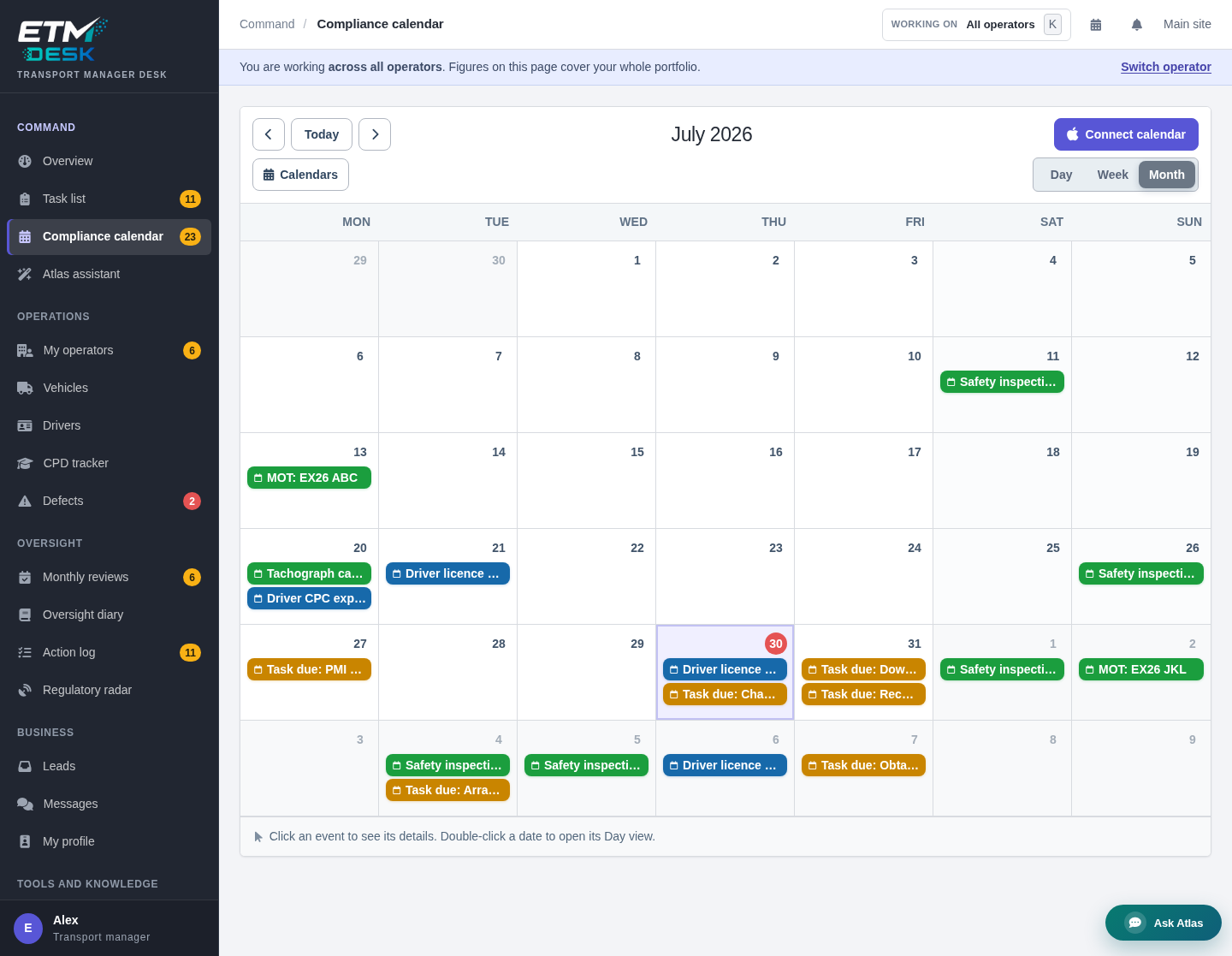
The daily overview brings overdue work and upcoming obligations together. Tasks can be created directly or proposed by Atlas for review. Defect records follow the issue through rectification. The compliance calendar is connected to underlying records rather than existing as a separate diary.
ETM also connects this work to the main platform. A transport manager can build a profile, receive relevant leads, win an operator and then manage the engagement in the Desk.
Questions for a supplier demonstration
- Show how a defect moves from report to rectification evidence.
- Change an inspection date and show every place that updates.
- Show all overdue work across more than one operator.
- Open a closed task and show the full history.
- Produce the records another person would need to review the decision.
- Explain which data is imported, which is manually confirmed and which system remains the source.
For a closer look at the product, see ETM Desk’s transport manager software features. The ETM Desk pricing page compares the free, verified and premium levels.
Related guides
- Transport manager software: a practical UK buyer’s guide
- Fleet maintenance software for PMIs and defects
- Operator licence compliance and evidence trails
This article is general guidance, not legal advice. Operators and transport managers should work from their licence undertakings, current official guidance and the facts of their operation.
Request quotes from UK transport managers and consultants
Send one request through ETM and invite suitable listed providers to respond. Any quotes received are shown in your ETM dashboard and sent by email; responses depend on provider availability. Providers can help with operator licence compliance, DVSA audit preparation, drivers’ hours, maintenance systems and more.