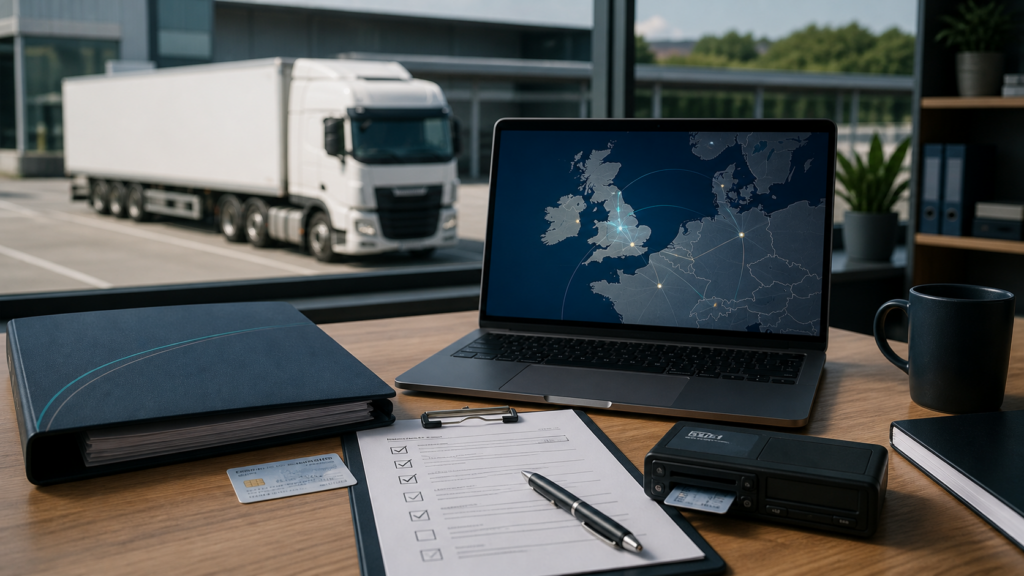
An International Transport Manager is responsible for professional competence on a standard international operator licence. The role is wider than holding a CPC certificate. It involves effective control over vehicles, drivers, maintenance, route planning, international paperwork, record keeping and the operator’s compliance decisions.
What international transport management covers
International work changes the management burden. Cross-border transport adds licence-scope questions, journey records, document checks, driver eligibility and operational planning that are not always present in a domestic-only operation.
| Area | International transport manager check | Why it matters |
|---|---|---|
| Licence type | Confirm standard international authority where required | Domestic authority may not allow the work being carried out |
| CPC scope | Check whether professional competence covers international operations | A national-only Transport Manager CPC cannot be used for nomination on a standard international licence |
| Vehicle records | Check maintenance, MOT, roadworthiness and trailer evidence | International work increases consequences when records are weak |
| Driver controls | Check licences, Driver CPC, tachograph use, hours and rest planning | Cross-border work can make hours control more complex |
| Journey paperwork | Check required documents before vehicles leave the UK | Missing documents can delay journeys and expose compliance gaps |
| Management evidence | Record decisions, checks, escalations and corrective actions | The role must be continuous and effective, not nominal |
Standard national compared with standard international
| Licence point | Standard national | Standard international |
|---|---|---|
| Goods work scope | Own goods in the UK and internationally, and other people’s goods in the UK | Own goods and other people’s goods in the UK and on international journeys |
| PSV work scope | Passenger vehicles within the UK, within the authorisation on the licence | Passenger vehicles in the UK and on international journeys, within the authorisation on the licence |
| Transport manager | Professional competence required | Professional competence must support international operations |
| Records | Domestic compliance records remain essential | Domestic records plus international journey and document controls |
| Risk | DVSA and Traffic Commissioner scrutiny | Same domestic scrutiny, plus overseas journey disruption if documents or planning fail |
International goods and PSV operations are different
Goods and passenger operations should not be treated as the same. A goods transport manager needs the correct road haulage competence. A PSV transport manager needs passenger transport competence. Where an operation has both goods vehicles and passenger vehicles, the competence, records and licence position should be checked separately.
Questions before appointing an international transport manager
Check the type of work, vehicle numbers, operating centres, journey pattern, driver arrangements, vehicle documents, previous compliance record and planned growth. Then check whether the proposed transport manager has the right CPC, enough hours and real authority over the operation.
Common weak points
International work often exposes weak planning. Examples include relying on a national-only CPC for an international nomination, unclear trailer records, poor tachograph controls, missing journey documents, no escalation process for driver hours, or a transport manager with too many commitments to provide effective management.
Related pages
Read more about standard international transport manager, international PSV transport manager, external transport manager cost and transport manager duties and responsibilities.
International transport manager responsibilities in practice
The practical role includes checking that the licence scope matches the work, that vehicles are maintained on time, that drivers are eligible and properly briefed, that tachograph rules are controlled and that journey documents are ready before the vehicle leaves the UK. The transport manager should also review what happens after each journey: delays, infringements, defects, missing documents and customer pressure should all feed into the next management decision.
International work can also change financial and operational risk. Longer trips, unfamiliar routes, ferry or tunnel delays, trailer use and overseas enforcement can all expose weak planning. A transport manager should be close enough to the operation to influence route planning, loading decisions, rest planning and vehicle availability.
Official sources: GOV.UK become a transport manager, GOV.UK goods vehicle licence types and GOV.UK PSV operator licensing guide.
Request transport compliance quotes
Discuss the work, experience and support your operation needs with independent providers. Request quotes with no obligation.
Get quotes now →